The word you want is ambipedal
Strictly speaking, ambidextrous was made for hands. The word comes from the Latin ambi- ("both") and dexter ("right"), so it literally means something like two right hands. Feet were never part of the original deal — although Merriam-Webster now lists a soccer sense too, using both feet with equal ease, so the usage is no longer wrong, just borrowed. The full story of the word is in ambidextrous meaning.
The word made for feet is ambipedal: ambi- plus ped-, both feet. In sport, and especially in football, almost nobody says that — they say two-footed.
So if you can kick, balance and push off equally well with either foot, you are ambipedal, or two-footed. And if you have ever wondered whether that is normal, the honest answer is that it is rarer than you think, and far more trainable than you think.
Why the two words are not symmetrical
There is a small curiosity buried in the etymology that I find genuinely delightful.
Ambidextrous is a compliment baked into a word. Dexter in Latin did not only mean "right" — it also meant favourable, skilled, lucky. Its opposite, sinister, meant "left" and also unlucky. So calling someone ambidextrous is literally saying they have two good hands, two lucky hands.
Ambipedal carries none of that. Ped- is purely anatomical. Nobody in Rome thought one foot was morally superior to the other.
Which tells you something about how we treat the two halves of the body. We have spent centuries judging hands and almost entirely ignoring feet — and that neglect is exactly why foot dominance behaves so differently from hand dominance.
How common is it to be two-footed
Here the data is surprisingly good. A 2020 meta-analysis pooled 164 studies and 145,135 people to estimate how footedness is distributed[1]. Depending on how strictly you define it, between 12.1% and 23.7% of people are not straightforwardly right-footed.
Compare that with hands. The best estimate for left-handedness is about 10.6%, and only about 2% of people say they use both hands equally[3] — fewer still are equally skilled at everything.
The gap is the interesting part. Mixed-footedness is far more common than two-handedness. The same meta-analysis puts mixed-footers at about 20% of people — 18% of adults, 26% of children[1] — against the 2% who claim both hands. A likely reason is almost embarrassingly simple: school forced you to pick a hand for writing. Nothing ever forced you to pick a foot. The authors themselves note that culture shapes footedness only marginally, while it plays a crucial role for hands.
Your feet, in other words, were never disciplined. They kept an openness your hands lost at the age of five.
There is a second reason researchers care about feet.
Because footedness escaped the cultural pressure that shaped handedness — no teacher ever slapped a child's left foot — it may be a cleaner window onto how your brain is actually organised than handedness is.
One influential study found that footedness predicted emotional lateralisation better than handedness did[2].
Your feet, it turns out, may be more honest about your brain than your hands are.
Right-handed and left-footed
Now the fact that surprises almost everyone, including me when I first read it.
Cross-dominance is not evenly distributed. Among left-handers, roughly 60% are also left-footed — but among right-handers, only about 3% are left-footed[1].
Read that again. If you are left-handed, your feet probably followed your hands. If you are right-handed, they almost certainly did too — but a large slice of right-handers, about one in five, sit in the mixed-footed middle, using different feet for different jobs without ever noticing[1].
That middle group is the one I care about, because it includes a lot of people who assume they are entirely right-side dominant and are quietly wrong. You might kick a ball right-footed, hop better on your left, and trap a pass with whichever foot arrives first.
If you have never actually checked which side you favour, the ambidextrous test is the fastest way to find out where you are starting from. It measures hands, but the pattern it reveals is usually the same one your feet follow.
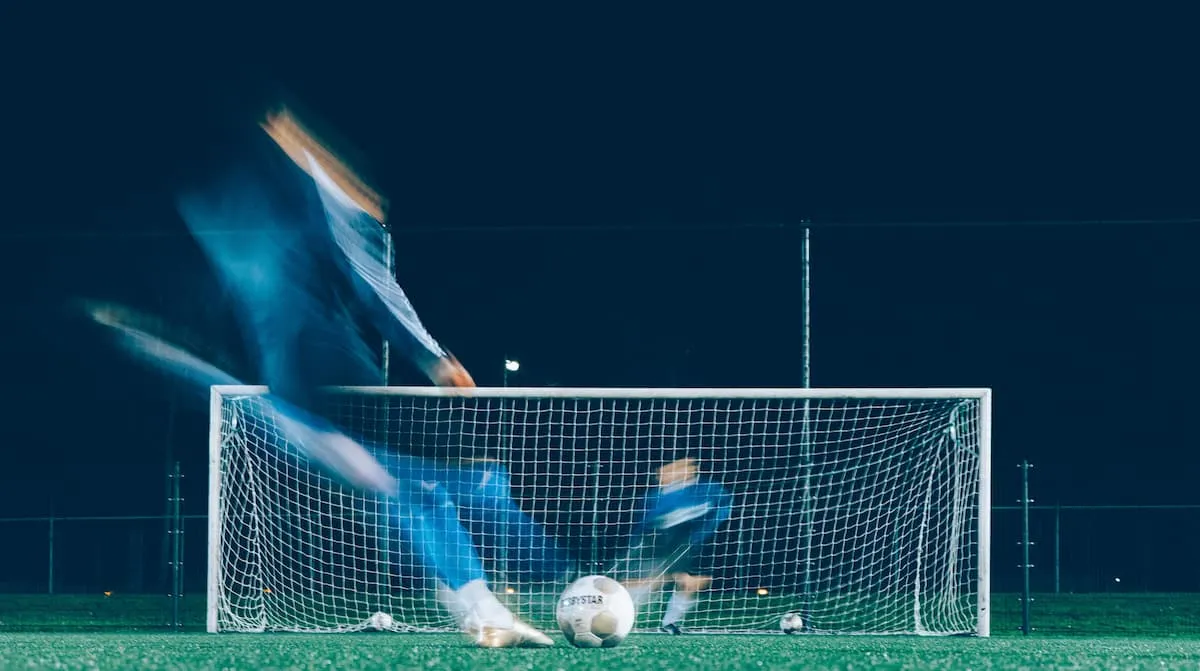
Why footballers are the exception
Athletes are different, but not in the way you would guess. The same meta-analysis found left-footedness elevated in athletes, 20% against 11% in everyone else, yet no difference at all in mixed-footedness[1].
That points to selection: a left-footed player is scarce and therefore valuable, so more of them make it. Training volume, on its own, does not show up in the numbers. A professional has kicked a ball more times by sixteen than most of us will in a lifetime, and coaches drill the weak foot relentlessly, because a one-footed player is a predictable player — and still the preference survives.
Even so, genuinely two-footed professionals stay rare: of 236 players at the 1998 World Cup, very few used each foot equally often[5]. If that many professionals never fully develop the second foot, it tells you something honest about how much work it takes.
I have written separately about what being ambidextrous means in football, including which players actually deserve the label.
Can you train your weaker foot
Yes — and more easily than you can train your weaker hand.
Writing is a fantastically precise task: your dominant hand has decades of fine-motor programming that your other hand simply does not have. Kicking, balancing and pushing off are gross motor skills. The gap between your two feet is smaller to begin with, so it should close faster.
There is also a genuine assist from your nervous system. Practising a movement with one limb produces measurable improvement in the untrained limb on the opposite side — an effect called intermanual transfer, well documented for hands[4] and studied in the legs too, under the name cross-education[6].
Expect awkwardness for the first two or three weeks. Expect it to feel like your leg belongs to someone else. That feeling is the point — it is what learning actually feels like from the inside.
Four drills for your weaker foot
-
Stand on it. Single-leg balance, barefoot, 60 seconds each side, eyes open. When that gets easy, close your eyes. This is the cheapest and most useful drill on the list.
-
Wall passes. Ten minutes, weak foot only, against a wall. Not powerful — accurate. Aim at a specific brick and keep aiming at it.
-
Stairs. Lead with the weaker foot every time you go up a step, for a week. You will forget constantly. That is fine, just restart.
-
Toe pickups. Pick a sock up off the floor with your toes, weak foot only, ten times a day. Absurd, mildly humiliating, and genuinely effective for foot dexterity.
Ten focused minutes beats an exhausted hour. Consistency is the whole game.
The same logic applies to hands, and if you want the fuller version of this I have collected the whole set in my guide to exercises to become ambidextrous.
Have you tried training your weak foot? If this was useful, share it with a teammate who only ever kicks with one foot.
Both hands, both feet
Training your weaker foot teaches you something that goes well beyond football: the side of your body you have been ignoring is not incapable, it is just untrained.
That realisation is what sent me down this road in the first place. I started with my hands, expecting very little, and found a level of control I had assumed was simply not available to me. The feet came later, and easier.
In my book "How to Become Ambidextrous" I have put together the structured version of that journey — a full assessment, dozens of graded exercises for writing, drawing and coordination, and a day-by-day programme for turning your non-dominant side from a passenger into a partner.
It is the guide I wanted when I began, and I wrote it for people who are curious enough to actually try.

Frequently asked questions
What is it called when you can use both feet?
The correct term is ambipedal, from the Latin ambi- (both) and ped- (foot). In sport, and especially football, the everyday word is two-footed. Ambidextrous was coined for hands, from ambi- and dexter, meaning roughly two right hands, though Merriam-Webster now also lists a soccer sense for feet.
Does ambidextrous apply to feet?
Originally no. Ambidextrous derives from the Latin dexter, meaning right hand, so it was coined for hands. Usage has stretched, though: Merriam-Webster now lists a soccer sense, using both feet with equal ease. The more precise words are still two-footed and ambipedal.
How rare is it to be ambidextrous with your feet?
Being mixed-footed is common; being equally good with both feet is rare. A meta-analysis of 164 studies found that between 12.1% and 23.7% of people are not clearly right-footed, and about one in five is mixed-footed. Among right-handers, only around 3% are left-footed.
How do you become ambidextrous with your feet?
Yes, and usually faster than training your weaker hand. Kicking and balancing are gross motor skills, so the starting gap between your two feet is smaller than the gap between your two hands. Ten focused minutes a day of balance and passing work produces noticeable change within a few weeks.
Can you be right-handed and left-footed?
Yes, though it is far more common the other way round. Around 60% of left-handers are also left-footed, while only about 3% of right-handers are. A much larger share of right-handers, about one in five, are mixed-footed and use different feet for different tasks without realising it.
- Four meta-analyses across 164 studies on atypical footedness prevalence and its relation to handedness
- Footedness is a better predictor than is handedness of emotional lateralization
- Genome-wide association study identifies 48 common genetic variants associated with handedness (Cuellar-Partida et al., 2021)
- Specialization in interlimb transfer between dominant and non-dominant hand skills
- Footedness in world soccer: an analysis of France '98 (Carey et al., 2001)
- Neural pathways mediating cross education of motor function (Ruddy & Carson, 2013)